Why AI Productivity Gains Aren't Showing Up in Delivery Metrics
Individual engineers are more productive with AI tools. Team delivery metrics are flat. The gap is organizational, not technical — and it has a specific cause.

Engineering teams are reporting significant productivity gains from AI tools. Individual developers describe completing in hours what previously took days. AI coding assistants, generation tools, and agent workflows have measurably sped up specific tasks. And yet, according to 2026 engineering delivery benchmarks and consistent reporting from engineering leaders including Gergely Orosz of The Pragmatic Engineer, company-wide delivery metrics — throughput, deployment frequency, lead time, change failure rate — have mostly remained flat.
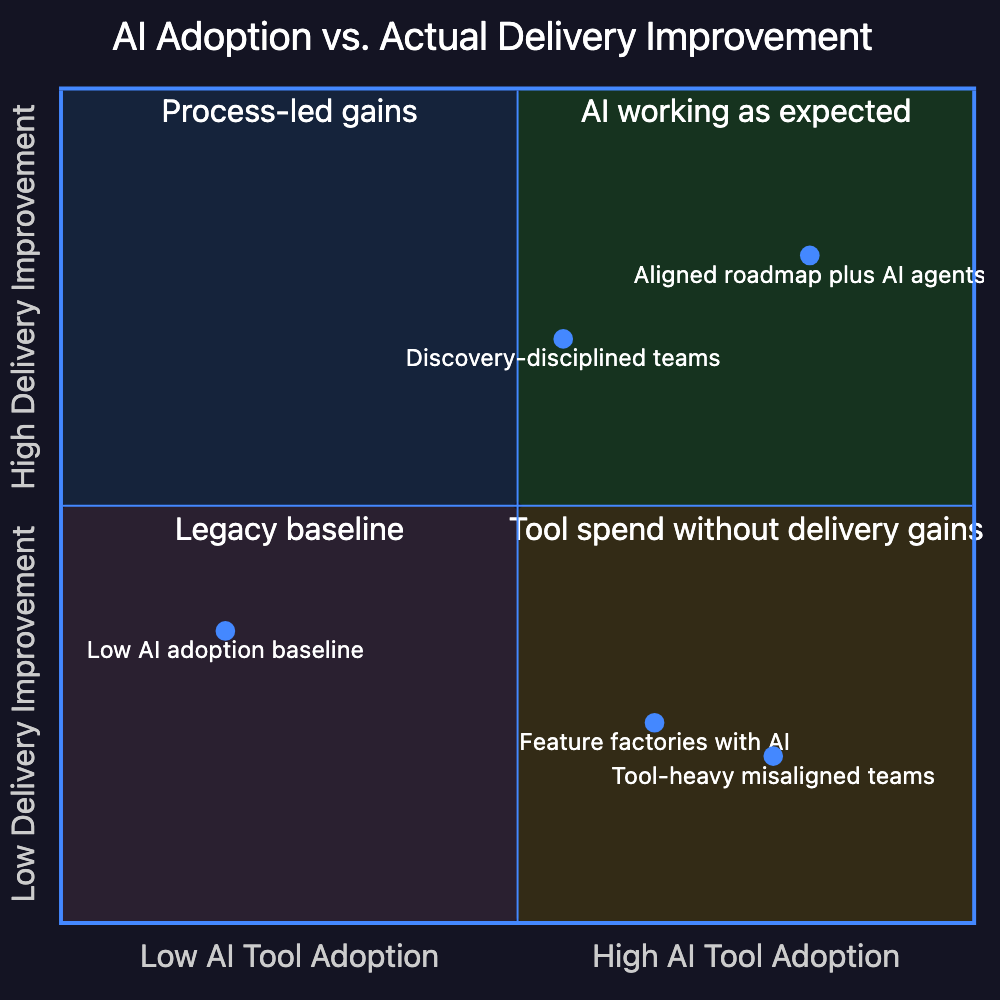
This is not a surprise. It is a pattern. The most accurate description of what AI does to a software organization is that it amplifies what is already there.
quadrantChart
title AI Adoption vs. Actual Delivery Improvement
x-axis Low AI Tool Adoption --> High AI Tool Adoption
y-axis Low Delivery Improvement --> High Delivery Improvement
quadrant-1 AI working as expected
quadrant-2 Process-led gains
quadrant-3 Legacy baseline
quadrant-4 Tool spend without delivery gains
Aligned roadmap plus AI agents: [0.82, 0.80]
Discovery-disciplined teams: [0.55, 0.70]
Low AI adoption baseline: [0.18, 0.35]
Tool-heavy misaligned teams: [0.78, 0.20]
Feature factories with AI: [0.65, 0.24]
Individual velocity and team delivery are different measurements
The gap between what individual engineers experience and what engineering leaders observe in aggregate is documented. Gergely Orosz has reported that while engineers at leading AI-adopting organizations describe dramatic acceleration in their own work, delivery-level metrics that engineering organizations actually track — cycle time, quality, deployment frequency — are often unchanged.
The reason is structural, not technical. Engineering delivery is a system. Individual contributors participate in that system but do not determine its throughput alone. Cycle time is constrained by review processes, approval workflows, dependency chains, and deployment pipelines. AI tools that make individual contributors faster do not automatically remove these constraints. In some cases they surface them more sharply — a faster development cycle now stalls visibly at the same bottlenecks that were always there.
This is what the "mirror and multiplier" characterization means. AI is not a productivity shortcut applied evenly across an organization. It is a capability multiplier applied to the people and processes already present. In organizations with solid delivery foundations — clear priorities, aligned teams, tight feedback loops — AI amplifies those strengths. In organizations with weak foundations, AI amplifies those too.
Product managers: AI velocity is a forcing function on discovery clarity
The practical implication for product management is that AI-accelerated engineering velocity puts pressure on the quality of upstream inputs. When the development cycle compresses, any imprecision in requirements reaches production faster.
Teams running discovery processes that produce vague or incompletely validated specifications will ship those specifications into production at a pace that was previously impossible. The problem is not the speed. The problem is the precision of what is being accelerated.
What changes for product managers in this environment:
Discovery cannot run on traditional quarterly cycles. If engineering is delivering faster, the upstream process needs to produce validated, precise inputs at the same rate. That requires continuous discovery — not a research phase — and tight integration between discovery and delivery so that what engineers receive is already validated, not just estimated.
The build trap accelerates. Building features without validated outcome hypotheses has always been costly. When the feature cycle compresses, the cost of building the wrong thing increases proportionally. Teams already optimizing for output over outcome will find AI makes that dynamic more visible, not less.
Outcome metrics matter more, not less. Faster shipping with flat retention, activation, or engagement is a more pressing signal in an AI-accelerated environment. Product managers who track outcome metrics will identify drift from validated hypotheses before it compounds; those tracking feature completion metrics will find the gap harder to see until it is large.
Executives: the ROI is organizational, not technical
The reason AI productivity investments are not producing proportional delivery improvements at the company level is that the constraint is organizational, not technological.
The RACER framework — assessing Roadmap focus, Alignment, Constraints, Evidence, and Responsiveness — was developed specifically to evaluate why AI delivery gains are unevenly distributed. All five factors are organizational. None are determined by which AI tools are licensed. The organizations seeing delivery improvements from AI are not the ones with the most sophisticated tools. They are the ones with the clearest priorities, the least work-in-progress, and the shortest feedback loops from delivery to evidence of outcome. The tools amplified existing strengths.
For technology executives evaluating AI productivity investments:
Tool adoption is necessary but not sufficient. The organizations seeing delivery improvements had already addressed fundamental alignment problems before adopting the tools. The tools amplified what was already there. Without that foundation, tool adoption produces more output pointed in more directions.
Headcount decisions should follow delivery data, not individual productivity reports. The gap between individual-reported productivity gains and team-level delivery outcomes is significant enough that capacity decisions made on individual productivity data alone will produce wrong conclusions. The relevant question is whether the system is producing better outcomes, not whether individuals are producing more output.
The prerequisite investments are organizational. Roadmap clarity, priority alignment, and short feedback loops between delivery and evidence are prerequisites for AI-driven delivery improvement. Organizations that invest in AI tools before resolving those prerequisites should not be surprised when delivery benchmarks do not reflect the tool investment.
Our take
One of the patterns we've seen across large-scale engagements is the multiplier effect of organizational alignment — in both directions. A large title insurance and real estate platform client we worked with had dozens of product and engineering teams operating with conflicting roadmaps and no shared definition of "done." The first work we did was not technology work. It was establishing a product model that teams across the organization could align to before any new feature work began.
If that organization had adopted AI engineering tools before that alignment work was complete, the productivity gains at the individual level would have been real. Dozens of teams moving faster in different directions produces more output, not better delivery. The constraint was never developer throughput. It was organizational coherence.
That is the pattern the 2026 delivery benchmarks are documenting. The organizations not seeing delivery improvements have bought tools before solving the problem tools cannot solve. Getting the alignment work done first is not a prerequisite that can be skipped because the tools are good. It is the prerequisite that determines what the tools can do.
Frequently Asked Questions
Why aren't AI tools improving our team delivery metrics if individual engineers are more productive?
Individual productivity and team delivery throughput are different measurements of different systems. An individual engineer producing more output per day does not automatically increase team delivery velocity if the constraints on that velocity are review cycles, approval workflows, dependency chains, or deployment pipelines that AI tools do not affect. The organizations seeing delivery-level improvements from AI are those that had already resolved their fundamental alignment and priority problems before adopting the tools. AI amplifies what is already there — coherent teams get faster; fragmented teams produce more output in more directions. The tool is working; the system it is operating within determines whether that shows up in delivery metrics.
What organizational factors predict whether AI tools will improve engineering delivery outcomes?
The RACER framework, developed to assess AI delivery outcomes, identifies five factors: Roadmap focus, Alignment, Constraints, Evidence, and Responsiveness. All five are organizational characteristics, not technical ones. Teams with clear priorities, low work-in-progress, short feedback loops from delivery to evidence of outcome, and tight integration between discovery and delivery tend to see AI tooling produce delivery improvements. Teams without these characteristics tend to see AI produce more output without a corresponding improvement in throughput, quality, or deployment frequency. The tools are not the variable; the organizational foundation is.
Should we invest in more AI tools if our current AI tooling isn't improving delivery benchmarks?
More tools are unlikely to resolve a gap that is already organizational in origin. The organizations seeing delivery improvements from AI had addressed their fundamental alignment and clarity problems before the tools were adopted — the tools then amplified existing strengths. If delivery metrics are flat despite AI tool adoption, the productive diagnostic is not tool selection but organizational structure: Are priorities clear enough to direct agent output toward outcomes? Are discovery and delivery tightly enough integrated that validated specs reach engineers before work begins? Is the review function maintaining quality at the pace agents are generating output? Resolving those questions first changes what AI tools can produce.