Product Discovery vs. Product Delivery: Why Most Teams Get the Balance Wrong
Most product teams run discovery and delivery as separate tracks — and wonder why shipped features don't move metrics. Here's what a healthier balance looks like.

Most product teams have a discovery problem. Not because they skip discovery entirely, but because they do it at the wrong time, in the wrong order, and then hand off the output as if the answers are settled.
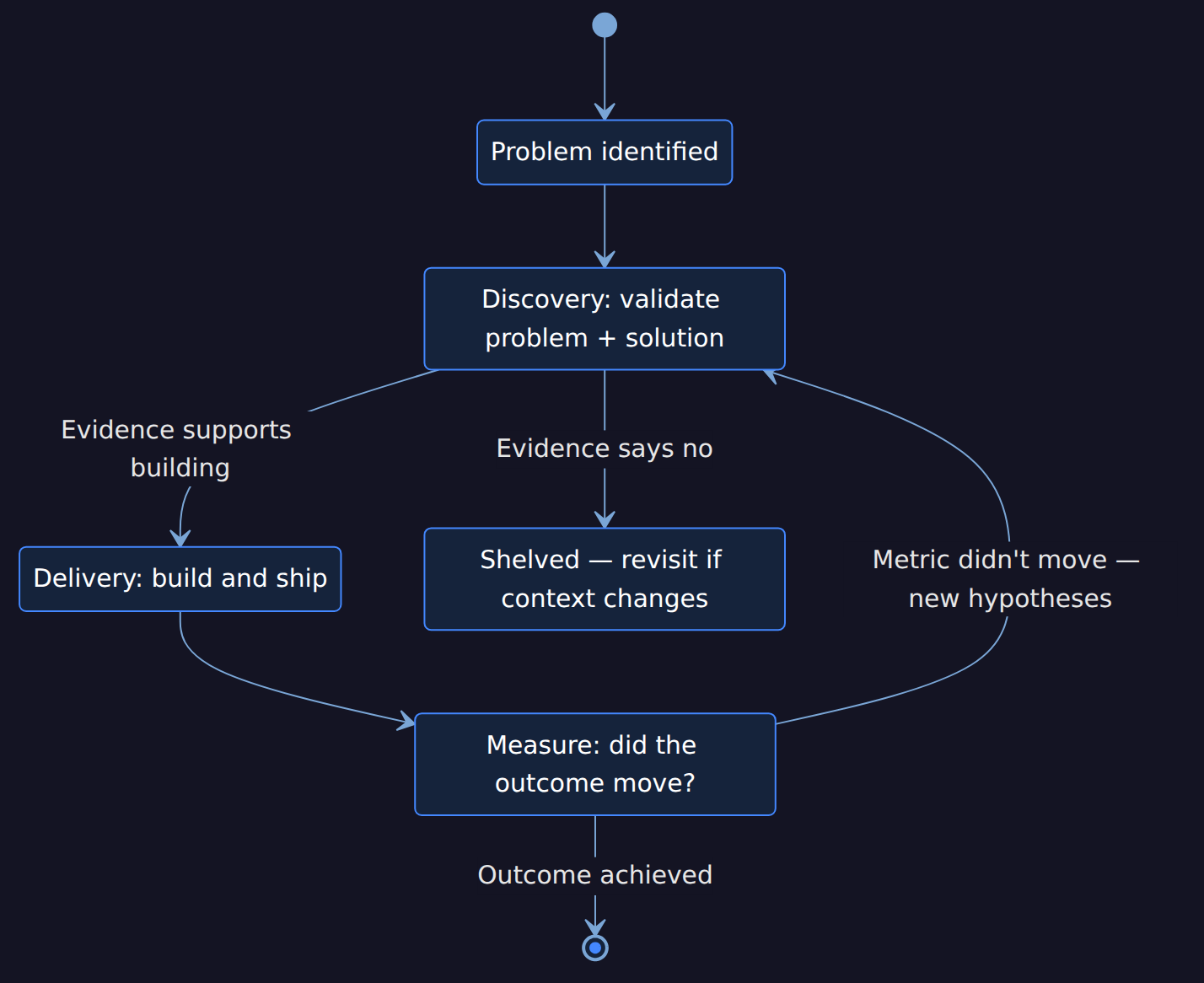
The pattern looks like this: a problem gets identified, a feature gets scoped, discovery happens as a formality to fill in the spec, and then delivery begins. When the shipped feature doesn't move the metric it was supposed to move, the team cycles back and calls for another discovery sprint — as if discovery were a phase to be completed, rather than a continuous practice.
stateDiagram-v2
direction TB
state "Problem identified" as P
state "Discovery: validate problem + solution" as D
state "Delivery: build and ship" as Del
state "Measure: did the outcome move?" as M
state "Shelved — revisit if context changes" as S
[*] --> P
P --> D
D --> Del : Evidence supports building
D --> S : Evidence says no
Del --> M
M --> D : Metric didn't move — new hypotheses
M --> [*] : Outcome achieved
The underlying mistake is treating discovery and delivery as a pipeline — a serial process where one completes before the other begins. In practice, they are parallel and continuous. A team that has figured this out is always building something validated and always validating something it will build next.
What Discovery Actually Is (and Isn't)
Discovery is not user interviews. User interviews are one tool in discovery. Discovery is the broader practice of reducing uncertainty before committing engineering time.
It includes testing whether the problem is worth solving, whether the solution addresses the problem in the way users actually need, and whether users can accomplish the goal with the proposed design. Each of those is a separate question, and each can be tested with much less effort than a full build — if the team builds that habit.
The teams that do this well treat discovery as a continuous investment, not a gate. At any given time, they're building a known-good thing and testing the assumptions behind the next thing. The teams that struggle treat it as a phase — something that happens before a big effort begins, produces a spec, and then concludes.
Why Delivery Pressure Kills Discovery
The most common explanation for skipped discovery is time: "we don't have capacity." But the real constraint is usually incentive. In most organizations, delivery is visible and discovery is not. A shipped feature appears in a changelog. A validated learning — "we tested three versions and one worked, so we're not building the other two" — disappears into a Confluence page.
When performance is measured by features shipped or velocity points, teams optimize for the visible thing. Discovery gets crowded out not because it doesn't create value, but because it doesn't create the kind of value that gets counted.
We've seen this pattern directly in engagements with enterprise clients where product teams are staffed and empowered, but leadership reviews focus on delivery dashboards. The teams know they should spend more time in discovery. They don't, because the signals they receive reward output, not outcomes.
Fixing this requires changing what leadership tracks. When the question shifts from "how many features did we ship?" to "how many of the features we shipped moved the metric they were intended to move?" — discovery becomes a rational investment rather than an optional step.
The Practical Structure That Works
Teams that integrate discovery effectively tend to run it one sprint ahead of delivery. The model is simple:
- A small discovery squad — typically product manager, designer, and one engineer — works one sprint ahead of the delivery team
- What the delivery team builds this sprint was validated last sprint
- What the discovery squad validates this sprint will be built next sprint
This structure does two things. First, it creates a continuous queue of validated work, so delivery is never blocked waiting for clarity. Second, it keeps the discovery squad small enough to move quickly — a full cross-functional team running discovery is usually too slow and too attached to the output to test it honestly.
The most important constraint is that the discovery squad must be genuinely empowered to kill ideas. If every validated concept goes to delivery regardless of what the testing shows, the discovery is theater. The value is in the work that gets stopped early.
The Signal That Discovery Is Working
When discovery is working, the delivery team should occasionally hear: "We tested three approaches this sprint. Two of them failed in user testing, and we're not building them. We're building the third." That outcome — three potential sprints of work reduced to one — is what good discovery looks like.
Teams that never kill anything in discovery are either testing ideas that are too safe to fail, or they're not actually letting the evidence change the outcome. The kill rate is the signal.
If your team ships everything it discovers, you're not doing discovery. You're doing research-flavored documentation.
Frequently Asked Questions
What is the difference between product discovery and product delivery?
Discovery is the work of figuring out what to build — identifying the right problem, generating solution options, and testing assumptions quickly and cheaply before committing engineering time. Delivery is the work of building the validated solution at production quality. Both are necessary; the mistake is treating them as sequential phases rather than continuous, overlapping activities.
How much time should a product team spend on discovery?
There's no universal ratio, but most teams that struggle with delivery are spending less than 20% of their time in genuine discovery. A healthy team typically runs discovery in parallel with delivery — using a small slice of capacity to continuously test the next wave of work while the current wave is in development. The right ratio depends on how much uncertainty exists in the problem space.
Why do teams avoid product discovery even when they know they should do it?
Delivery pressure is the most common reason. When stakeholders measure success by features shipped rather than outcomes achieved, teams optimize for the visible work. Discovery produces evidence, not demos, so it often loses the internal competition for time and resources. The fix is redefining what 'progress' looks like at the team and leadership level.
How do you integrate discovery and delivery in a sprint-based team?
The most practical approach is to run discovery one sprint ahead of delivery — what's being built now was validated last sprint; what's being validated now will be built next sprint. A small discovery squad (typically PM + designer + one engineer) works ahead of the delivery team, ensuring that by the time engineering picks up a story, the key assumptions have been tested.