The Integration Layer Is Where Enterprise AI Projects Actually Fail
Most enterprise AI pilots work and most enterprise AI products never ship. The gap is not the model — it is the integration architecture between the model and the systems of record. Here is what that failure looks like…

In McKinsey's and MIT's running surveys on enterprise AI adoption, the same shape keeps appearing: a large majority of organizations have run generative-AI pilots, and a small minority have put them into production at scale. The pilots, by and large, worked. The production systems, by and large, did not arrive.
The standard explanation is that the models aren't good enough yet. That explanation is mostly wrong. The model is rarely the thing that failed. What failed is the integration layer between the model and the systems where the enterprise actually keeps its data and runs its business — and that layer is ordinary custom software engineering that the pilot's success made look optional.
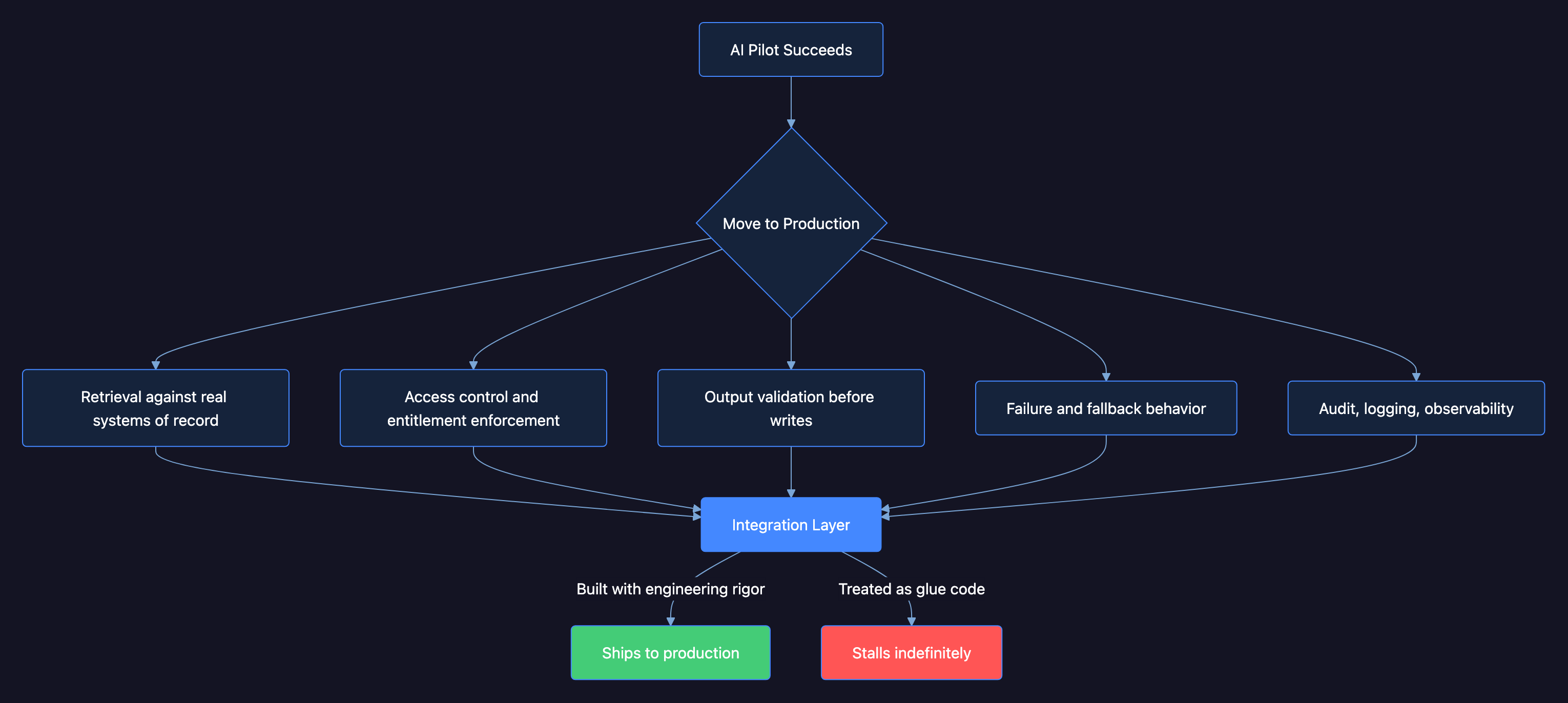
flowchart TD
    A[AI Pilot Succeeds] --> B{Move to Production}
    B --> C[Retrieval against real systems of record]
    B --> D[Access control and entitlement enforcement]
    B --> E[Output validation before writes]
    B --> F[Failure and fallback behavior]
    B --> G[Audit, logging, observability]
    C --> H[Integration Layer]
    D --> H
    E --> H
    F --> H
    G --> H
    H -->|Built with engineering rigor| I[Ships to production]
    H -->|Treated as glue code| J[Stalls indefinitely]
    style I fill:#44cc77,color:#fff
    style J fill:#ff5555,color:#fff
    style H fill:#4488ff,color:#fff
A pilot is a test of the model. Production is a test of the system around the model. Those are different things, and conflating them is the single most expensive mistake in enterprise AI right now.
The Reason Is Structural, Not Technical
A pilot is generous by construction. The data is hand-curated and clean. A human reviews every output before it matters. The model runs in a sandbox with no obligation to respect production access controls, no audit requirement, no service-level expectation, and no malformed input. Under those conditions, a capable model produces impressive results. That is real, and it is also nearly meaningless as a predictor of production readiness.
Production removes every one of those allowances at once. The model must now read context from the systems of record — a claims platform, an EHR, a case-management system, a logistics database — none of which were built to feed a model trustworthy, scoped, current context. It must respect the entitlement rules that govern which user can see which record. Its output, if it writes anything back, must be validated before it touches a database that the business depends on. And it must do something defined and safe when it is wrong, when a dependency is down, or when the input is nothing like the pilot data.
None of that is model work. All of it is integration architecture and custom software engineering. The teams that get stuck are the ones who budgeted for the model and assumed the rest was glue code.
For Architects and Engineering Leaders: the Integration Layer Is the Product
Treat retrieval as a first-class subsystem, not a prompt detail. The quality of an enterprise AI system is bounded by the quality of the context it retrieves. A model reasoning over stale, over-broad, or wrongly-scoped data will produce confident, wrong answers no prompt can fix. The retrieval layer — what it indexes, how it scopes by entitlement, how fresh it is — deserves more design attention than the model choice.
Put deterministic guardrails around non-deterministic components. The model is probabilistic; the systems of record are not allowed to be. The integration layer is where you reconcile that: validation that rejects malformed output, deterministic paths for cases that should never go to a model, and explicit boundaries on what the model is permitted to write. The failure mode here is letting probabilistic output flow unchecked into a system that assumed deterministic inputs.
Design the failure behavior before the happy path. In a pilot, "the model was wrong" is a footnote. In production, it is a requirement. Every model call needs a defined answer to: what happens when this is wrong, when this times out, when this returns nothing. Systems that ship have this designed in. Systems that stall discover the question in their first incident.
For Executives and Technology Decision-Makers: Budget for the System, Not the Model
The model is the cheap part. The licensing cost of a frontier model is small next to the engineering cost of integrating it safely into your environment. When a vendor demo or an internal pilot makes the capability look solved, what has been proven is that the model works — not that your organization can run it in production. The remaining work is most of the work, and it is custom software development against your specific systems.
Buy the commodity, build the integration. The model, the orchestration framework, the vector store — these are increasingly things to buy. The integration into your claims system, your entitlement model, your compliance regime is custom by necessity, because no platform knows your environment. Funding an AI initiative as if it were a software-purchase decision, rather than a custom-build decision, is how organizations end up with an impressive pilot and no production system a year later.
Measure progress by integration milestones, not demo quality. A better demo is not progress toward production. Retrieval quality against real data, validated writes, enforced access control, and defined failure handling are progress. If the status updates are about the model's outputs rather than the system around it, the project is measuring the wrong thing.
The Pattern We See in Client Work
We were brought into an engagement with a healthcare claims organization that had a generative-AI pilot leadership loved: it summarized claims and suggested adjudication outcomes, and in the demo it was fast and accurate. Eighteen months of attempts to productionize it had gone nowhere, and the assumption in the room was that the model needed to be better.
The model was fine. The pilot had run on a few hundred hand-cleaned claims with an analyst checking every output. Production required reading from the live claims platform with its real data quality, enforcing the entitlement rules that govern who can see which claim, validating every suggested outcome against business rules before it could be surfaced, and defining what the system does when it is uncertain — which, on real claims, was often. None of that had been built, because the pilot's success had made it look like the hard part was done.
The work that unblocked it was not AI work. It was a retrieval layer scoped to entitlements, a validation gate between model output and the adjudication system, and an explicit low-confidence path that routed claims to a human instead of guessing. Ordinary engineering, applied to the layer everyone had treated as an afterthought.
The model was never the hard part. The integration was the work, and it was the work the whole time.
Frequently Asked Questions
Why do so many enterprise AI pilots succeed but fail to reach production?
Because the pilot tests the model, and production tests the integration. A pilot runs against curated data, in a sandbox, with a human reviewing every output. Production requires the model to read from and write to systems of record, respect existing access controls and audit requirements, handle malformed and out-of-distribution inputs, and degrade safely when a dependency is down. The model that worked in the pilot is usually fine. The integration architecture that production requires was never built, because the pilot's success made it look unnecessary.
What is the integration layer in an enterprise AI system?
It is everything between the model and the enterprise's systems of record: the retrieval layer that feeds the model trustworthy context, the orchestration that decides when to call the model versus a deterministic path, the validation that checks model output before it touches a database, the access-control enforcement that ensures the model only sees data the requesting user is entitled to, and the observability that makes the whole thing debuggable. It is ordinary software engineering, and it is where most of the real work lives.
Should enterprises build the integration layer themselves or buy a platform?
The model and the orchestration framework are increasingly commodities worth buying. The integration into your specific systems of record, with your specific access model and compliance constraints, is almost always custom — no platform knows your legacy claims system or your entitlement rules. The practical pattern is to buy the model and the general-purpose tooling, and to treat the integration layer as custom software development with the rigor that implies: real interfaces, real tests, real failure handling.
How do you know if an AI project is at risk of the integration trap?
Ask where the demo's data came from and what happens when the model is wrong. If the demo data was hand-prepared and there is no defined behavior for incorrect output, the project has tested the model and not the system. The strongest signal of a production-ready effort is that the team has spent more time on retrieval quality, output validation, and failure handling than on prompt wording.