How to Build a Product Roadmap That Stakeholders Actually Trust
Most roadmap credibility problems aren't roadmap problems — they're communication and process problems. Here's what actually builds stakeholder trust over time.

The most common roadmap problem is not the roadmap itself. It's that stakeholders have learned, over time, not to believe it.
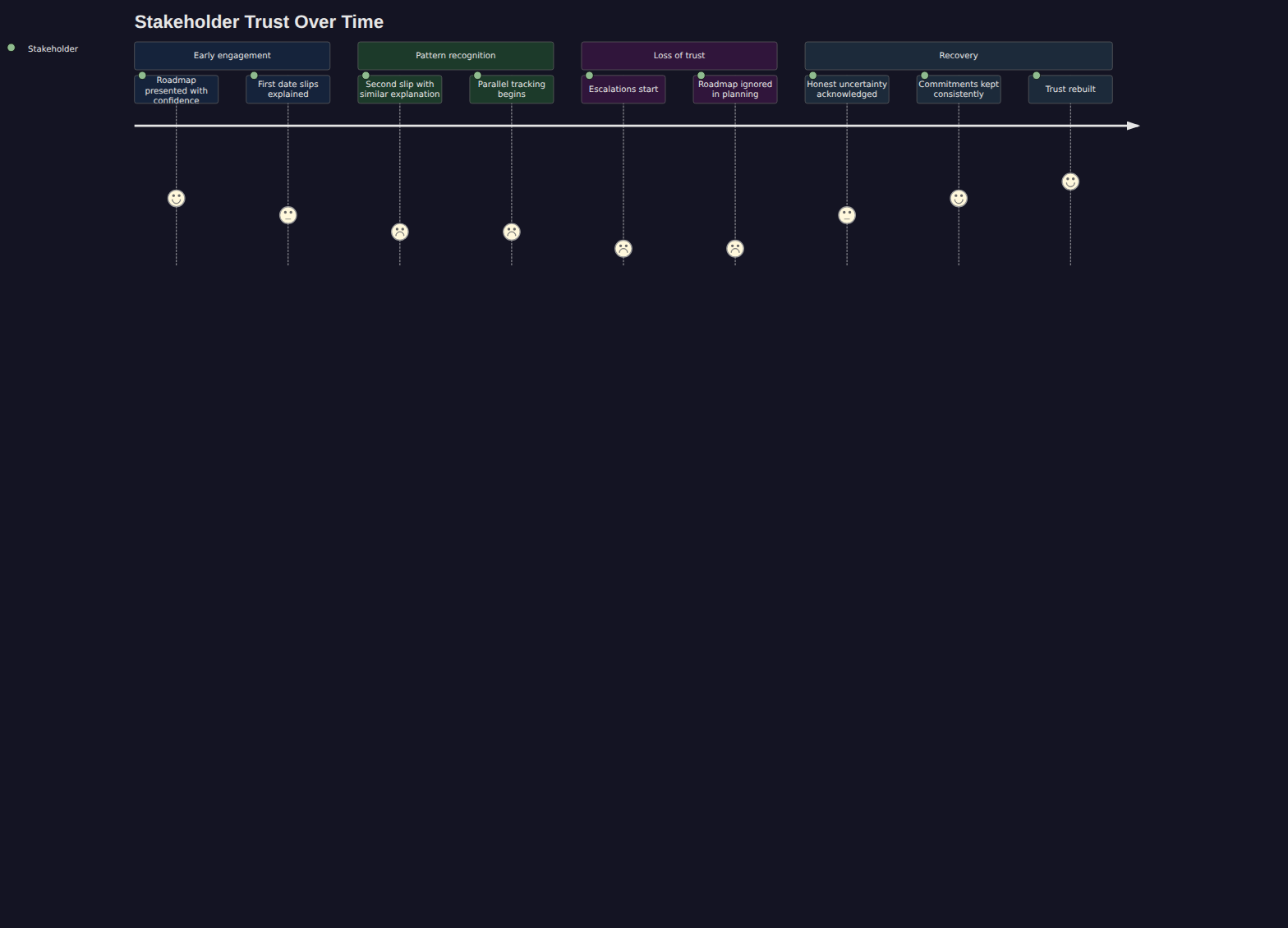
This happens predictably. A roadmap gets built. Commitments slip. The explanation — discovery took longer, engineering found complexity, priorities shifted — is accurate, but it keeps happening. Eventually stakeholders start maintaining their own timelines, building dependencies on earlier estimates, or escalating to leadership to get things prioritized. The roadmap becomes noise.
journey
title Stakeholder Trust Over Time
section Early engagement
  Roadmap presented with confidence: 4: Stakeholder
  First date slips explained: 3: Stakeholder
section Pattern recognition
  Second slip with similar explanation: 2: Stakeholder
  Parallel tracking begins: 2: Stakeholder
section Loss of trust
  Escalations start: 1: Stakeholder
  Roadmap ignored in planning: 1: Stakeholder
section Recovery
  Honest uncertainty acknowledged: 3: Stakeholder
  Commitments kept consistently: 4: Stakeholder
  Trust rebuilt: 5: Stakeholder
Rebuilding that trust is harder than building it in the first place, because stakeholders arrive at every roadmap review with accumulated skepticism. Getting it right the second time requires changing the process, not just the presentation.
The Trust-Destroying Patterns
Most roadmap credibility problems come from three patterns:
False precision. Dates further than 8 weeks out are usually guesses, but roadmaps present them with the same confidence as committed near-term work. When the Q3 dates slip into Q4, stakeholders don't update their model of how roadmaps work — they update their model of whether to trust this product team.
Missing the "why." When priorities change, stakeholders often find out through the roadmap changing, not through a conversation. The roadmap update is the first signal, and it arrives without the context that would make it make sense. From the outside, it looks like the team doesn't know what it's doing. From the inside, the team responded rationally to new information. Neither side communicates well enough to close that gap.
Outcome-free roadmaps. A roadmap that lists features without connecting them to outcomes gives stakeholders no way to evaluate whether the roadmap is the right roadmap. It's a to-do list, not a strategy. When a feature slips, there's no shared frame for assessing the impact, because no one agreed on what the feature was supposed to accomplish.
What Actually Builds Trust
Calibrated confidence levels. The simplest structural fix is to explicitly label the time horizon and uncertainty of each roadmap item. Committed work with clear scope can carry a date. Work 3–6 months out should carry a time horizon, not a date. Work beyond that should carry a theme or outcome, with no date at all. When stakeholders can see that the product team is being honest about uncertainty rather than pretending to know things it doesn't know, the credibility of the committed items goes up.
Explaining changes in advance. When a priority is going to shift, tell stakeholders before the roadmap changes, not after. A brief message — "we found in discovery that X is more complex than estimated; we're moving it to Q4 and here's what that means for Y" — prevents the experience of finding out that something moved by looking at an updated slide. The content of the news isn't the problem; the surprise is.
Outcome framing on the roadmap. Each major initiative should be attached to an outcome: what metric is it expected to move, for which users, by how much? This framing does two things. First, it forces the product team to have the outcome conversation before committing to a feature — which often changes what gets built. Second, it gives stakeholders a way to evaluate the roadmap independent of whether they agree with the specific features, because they can assess whether the outcomes are the right outcomes.
The Conversation That Resets the Dynamic
When stakeholder trust has eroded significantly, no amount of better roadmap formatting will fix it. The reset requires a direct conversation about the pattern, not the next roadmap item.
That conversation looks like: "I've noticed that our roadmap has missed its dates enough times that I think you've stopped believing it will be accurate. I want to understand what you need from the roadmap to make downstream decisions, and I want to be honest about what we can commit to versus what we're still learning." This is uncomfortable to initiate. It is consistently more effective than continuing to produce roadmaps that stakeholders discount before they're even read.
We've run this conversation directly in a client engagement where the product team had lost credibility with the executive team after two consecutive quarters of roadmap misses. The outcome of the reset conversation was a new operating model: a committed 6-week roadmap with explicit dates, and a 6-month horizon with themes and outcomes only. The executive team got the predictability they needed for operational planning; the product team got the flexibility it needed to respond to what it was learning. Neither party got the false precision that had been the source of the friction.
The Roadmap Is a Communication Tool
Product teams sometimes treat the roadmap as a planning tool — the output of an internal prioritization process. Stakeholders treat it as a commitment surface — the thing they use to make budget, headcount, and go-to-market decisions.
Both of those are legitimate uses. The problem is when the roadmap is designed for one use case and then read through the lens of the other. A roadmap built for internal planning will always disappoint stakeholders who need commitments. A roadmap built to satisfy stakeholder demands for certainty will always disappoint the team trying to use it to think clearly about strategy.
The fix is to build roadmaps that are explicit about what is committed versus what is directional, and to educate stakeholders about the difference. That education is ongoing — it doesn't happen once in a roadmap presentation. It happens every time the product team closes the loop on an outcome, updates an estimate with an explanation, or initiates the conversation when something is changing before the roadmap update is due.
Frequently Asked Questions
Why do stakeholders stop trusting product roadmaps?
Trust erodes when commitments slip repeatedly without explanation, when the roadmap changes without stakeholders understanding why, or when the priorities on the roadmap don't match what the team actually works on. The most common cause is that roadmaps are built as wish lists rather than commitments with explicit uncertainty levels — and stakeholders learn, usually after a few misses, that the dates are not real.
Should a product roadmap have dates?
It depends on how far out you're planning. Dates are appropriate for committed near-term work where the scope is well-understood and the team has capacity. For work three to six months out, time horizons (Q3, H2) are more honest than specific dates. For anything beyond six months, themes or outcomes without dates is more credible than false precision. The right level of time specificity should match your actual confidence level.
How do you handle stakeholders who demand certainty the product team can't provide?
The conversation needs to be reframed from 'will this be done by date X' to 'here is what we know, here is what we're still learning, and here is what would change our confidence.' Stakeholders often ask for certainty because they need to make downstream decisions. If you understand what decision they're trying to make, you can often give them what they actually need — which is a conditional commitment — rather than false precision.
What's the difference between a roadmap and a backlog?
A roadmap communicates strategic direction and near-term commitments to stakeholders outside the product team. A backlog is the ordered list of work for the team to execute. Roadmaps should be sparse, legible to non-technical audiences, and tied to business outcomes. Backlogs should be detailed, prioritized, and owned by the team. Conflating the two usually produces a roadmap that's too granular to communicate strategy and a backlog that's too abstract to be actionable.